
Find Springfield Residents by Record
No single file lists every person in Springfield. Instead, an address question usually runs through the assessor, the tax record, or the GIS parcel map. A name question works differently. It might call for a voter-status check, a public court index, a deed party, or a dated library source. Trust a result only when two independent details agree. A parcel ID plus a deed party is a solid pairing, and so is an old directory entry beside a newspaper date.
Owner, tax-mail recipient, voter, directory occupant, business officer, and court party are separate roles. Springfield's official records answer a specific fact well. They do not certify a complete household at one address. Remember what each source is. A current parcel entry carries its own date. An old directory is a publication snapshot, and a court index is not the court file itself.
- For an address, search the Springfield assessor or tax portal and record the parcel, situs, and date shown.
- Open the same parcel in City Web GIS to compare its geometry, owner/PID field, neighborhood, ZIP, and available property-card link.
- Confirm a property transfer through the Hampden Registry, where deeds connect recorded parties to a legal description and date.
- For an earlier person or address, compare city directories, newspapers, yearbooks, census material, and obituaries at the Library or archive.
- When a non-exempt record is not online, send a focused request to the custodian rather than guessing from a partial result.
Dates decide everything. The City tax history reaches back to 2004, while the Library's local directory collection stops at 1989. Probate online history covers its own separate span, so check before relying on any range.
Springfield Residents Records Offices
Each office in Springfield keeps one piece of the residents record trail. The Registry holds land instruments. Assessors and City Finance maintain the parcel and tax views, and Elections runs voter registration plus the annual municipal street listing. The City Clerk handles local municipal and historical-vital routing. For address-by-address work, the Springfield street directory traces the property chain in more detail.
Hampden Registry of Deeds
436 Dwight Street, Room B042
Springfield, MA 01103
413-755-1722
Springfield Assessors
Address and parcel search
City Hall and 311 fallback
Use the City portal first
Springfield Elections Office
City Hall, Room 8
Monday-Friday, 8:30 a.m.-4:00 p.m.
413-787-6190
Springfield City Clerk
36 Court Street, Room 123
Springfield, MA 01103
413-787-6094
Springfield Residents Directory Assessor Search
The assessor search is the best address-keyed starting point. Enter a parcel number or street address and pick the right autocomplete match. A street name alone browses every listed address on that road, and results can sort by street number or owner name. There is no owner-name input on this page. Name-first searching belongs in the separate tax-information portal instead. The Springfield assessor search displays the parcel and street controls that begin an address check.
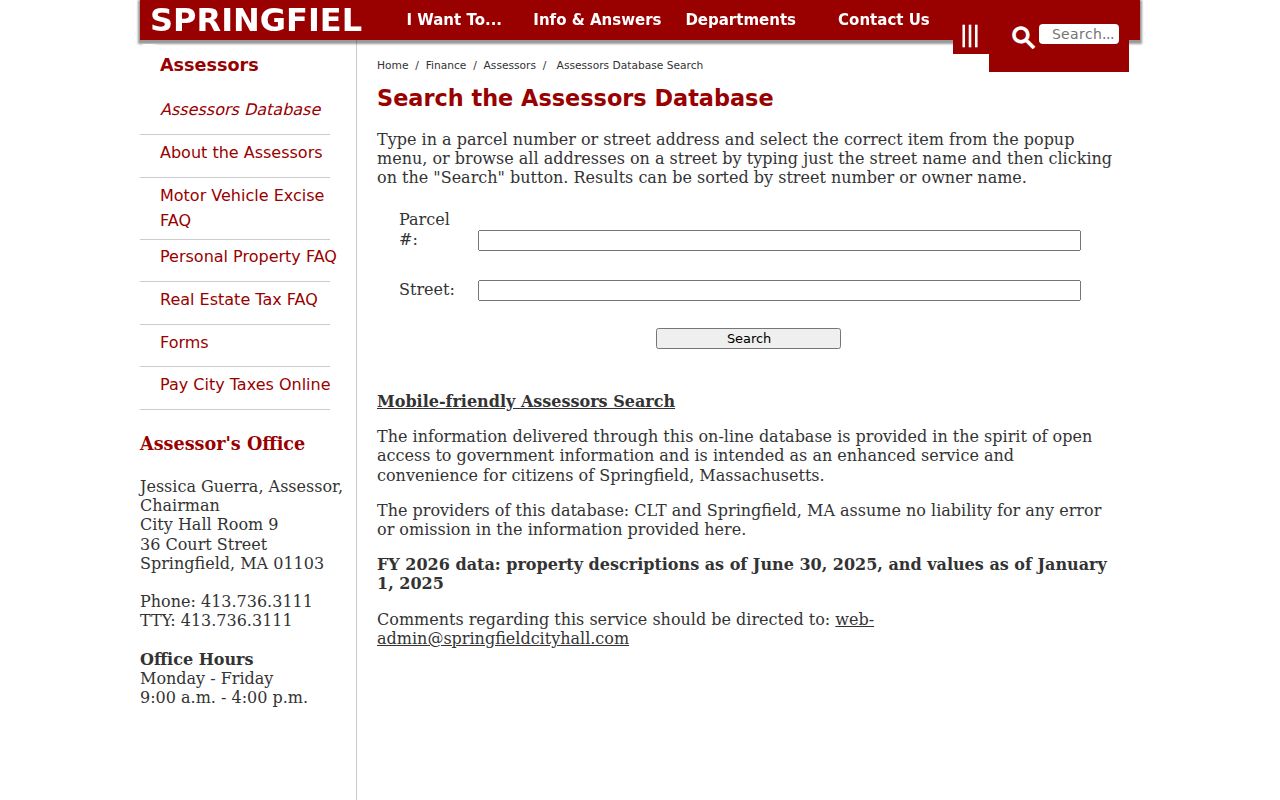
Springfield rolls its FY2026 property descriptions from June 30, 2025. Values are dated January 1, 2025. Treat those dates as fixed assessment points. A parcel record is not proof of who lives at an address now. Property rolls answer ownership questions; a Springfield residents directory answers residence questions.
| Assessor field | Type | Required | Use |
|---|---|---|---|
| Parcel # | Text | Optional | Enter a parcel number and choose the correct popup item |
| Street | Text with autocomplete | Optional | Use an address or a street name alone to browse |
| Popup selection | Autocomplete list | Practical requirement | Select the correct street or parcel result |
| Search | Button | Not applicable | Runs the address or street query |
| Sort | Result control | Optional | Sort results by street number or owner name |
Springfield Residents Directory Tax Clues
For a Springfield residents directory built on tax records, the owner name is the entry point. Type a tax-bill name last name first, no comma. A last name alone works too. The percent sign serves as a wildcard. Street abbreviations should match the tax bill itself, like ST. The portal also searches property record cards, tax history, and parcels carrying tax liens. A partial street term can match several roads. Compare the returned address before calling it a hit. The City tax-information portal then serves as a separate check. Run it for owner and property-card details after an assessor result.
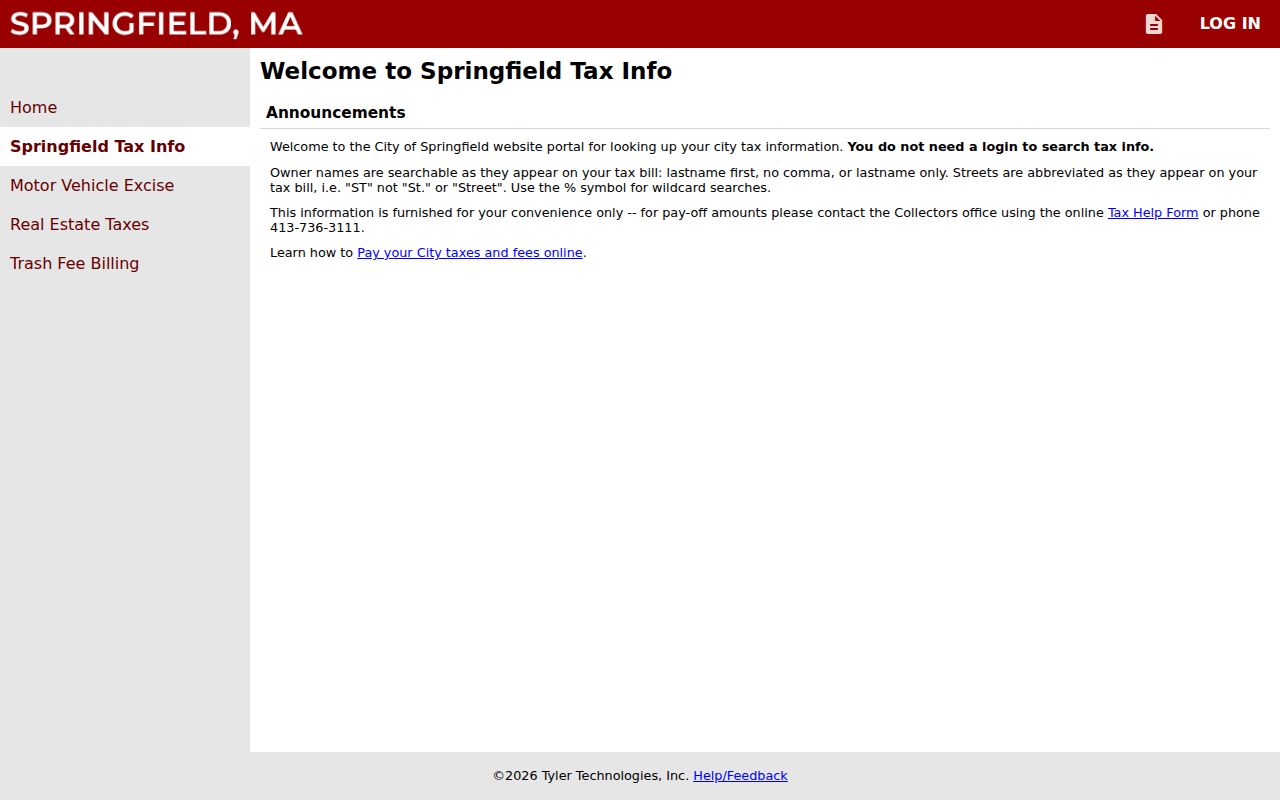
A separate tax-title search accepts Owner, Parcel Number, and Street. It also allows browsing by owner, street, street-parcel, and bill number. Through the Collector/Treasurer route, real-estate tax history reaches back to 2004. That depth makes it a useful layer in any Springfield street directory hunt. One caution: a tax-bill mailing address may sit outside the city. It is never the parcel's physical location.
Springfield Residents Directory Parcel Map
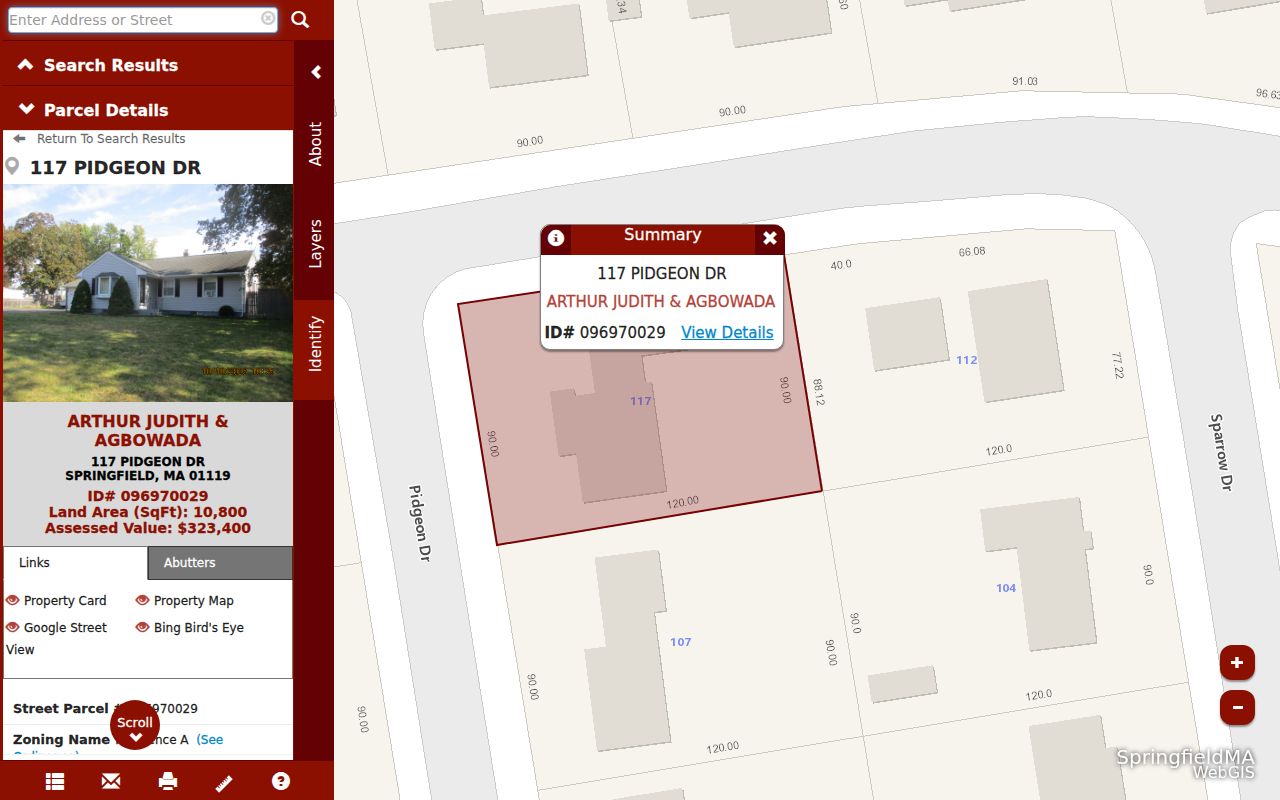
City Web GIS ties an address or street to a parcel outline. Search the address. Accept an exact or closest match. Then select the parcel and open View Details. The detail model goes deep. It can show a street address, owner, parcel ID, land area, and assessed-value concepts. It also offers links to a property card and map views. For a residents directory angle, that is a strong property connection. It stops short of listing everyone at the address. The Springfield GIS parcel view shows how address, owner/PID detail, and map controls meet in one screen.
The city GIS stacks many layers on one map. Parcels sit at the core. But you can also plot buildings, address numbers, lot lines, and ZIP codes. Neighborhoods, zoning, historic districts, and election wards and precincts appear too. So do policing sectors, wetlands, common-ownership parcels, and aerial imagery.
These layers overlap. They are not one shared set of boundaries. Before you match a result against a residents directory entry, a census tract, a ward label, or a ZIP code directory tag, note which layer produced it. That habit keeps a Springfield address lookup from drifting. The geographies were never drawn to agree.
Springfield Residents Directory Deed Index
The Hampden deed index carries the recorded ownership trail for Springfield property. Land records there run from 1636 straight through to the present. Depth like that matters for tracing past residents.
Later records search well. The index covers January 1, 1948 onward. From that point it answers to Name, Address, Book & Page, Year, Instrument Number, and Entry Date. Earlier instruments take a slower path. Pull the scanned Grantor or Grantee index first. Lift the book and page from it. Then circle back to Book & Page for the document image itself.
Names will fight you. Try spelling variants, initials, married names, and entity names before giving up on a deed. A street directory or city directory entry can help. It can confirm which spelling a family actually used in Springfield records.
The Springfield residents directory deed index splits land into two tracks. Recorded Land and Registered Land sit under separate search paths. A dead end on one deserves a try on the other. Registered Land works from certificate-of-title and document numbers. It skips the familiar book and page reference. Online deed copies are free through the Registry. Certified copies run $1 per page in person or by mail. The Registry also cautions against solicitations charging $121 for certified copies. Confirm any record purchase with the office itself.
Current Springfield Residents Sources
Each current Springfield resident lookup source answers a different question. Property rolls tie a name to tax or deed relationships. The voter route exposes only lawful fields through lawful access. Court indexes surface public case parties rather than a whole person. Corporate filings name entity roles and offices. These limits differ. Because of that, a Springfield residents directory picture comes together.
| Source | Who It Lists | Keeper | Access |
|---|---|---|---|
| Assessor and tax record | Tax-record owner and mailing clues tied to a parcel | Springfield Assessors and City Finance | Free address, parcel, owner, and tax-record routes |
| GIS parcel | Owner/PID link, parcel geometry, ZIP, neighborhood, and district context | City Web GIS | Free map; parcel-focused rather than person-focused |
| Deed index | Recorded grantors, grantees, and transfer parties | Hampden Registry | Free online copies; indexed search modes vary by era |
| Voter status or local file | Lawful registration, address, and status fields | Commonwealth and Springfield Elections | Individual status form or local-office request |
| MassCourts | Public court parties and case metadata | Massachusetts Trial Court | Remote public index; court file remains authoritative |
| Corporate filing | Entity officers, managers, signatories, registered agents, and offices | Secretary of the Commonwealth | Free search; filing images and coverage vary |
| City directory and yearbook | Historical address, affiliation, school, or occupation snapshot | Springfield City Library | Library or digitized collection; dated evidence only |
- Roll
- A list kept for a defined administrative purpose, such as a tax or registration function.
- Index
- A finding tool that points to an underlying record rather than replacing that record.
- Parcel
- The mapped land unit tied to an assessor or GIS identifier.
- Criss-cross directory
- A reverse address tool that can connect a number to a past published entry.
Do not assume one source supplies the facts carried by another.
Springfield Residents Directory Court Index
MassCourts is a statewide case index, not a full remote file room. It opens with a CAPTCHA and a public-search entry point. From there a visitor picks a court department, division, location where offered, and search mode. A civil name search needs a last name and first name. A company name works for organizations. Results can return a party or company. They may also list case number, case type, file date, party type, status, court, and affiliation. The MassCourts public search earns its place in a Springfield residents directory. It pins down a case reference before the holding court is contacted for the official file.
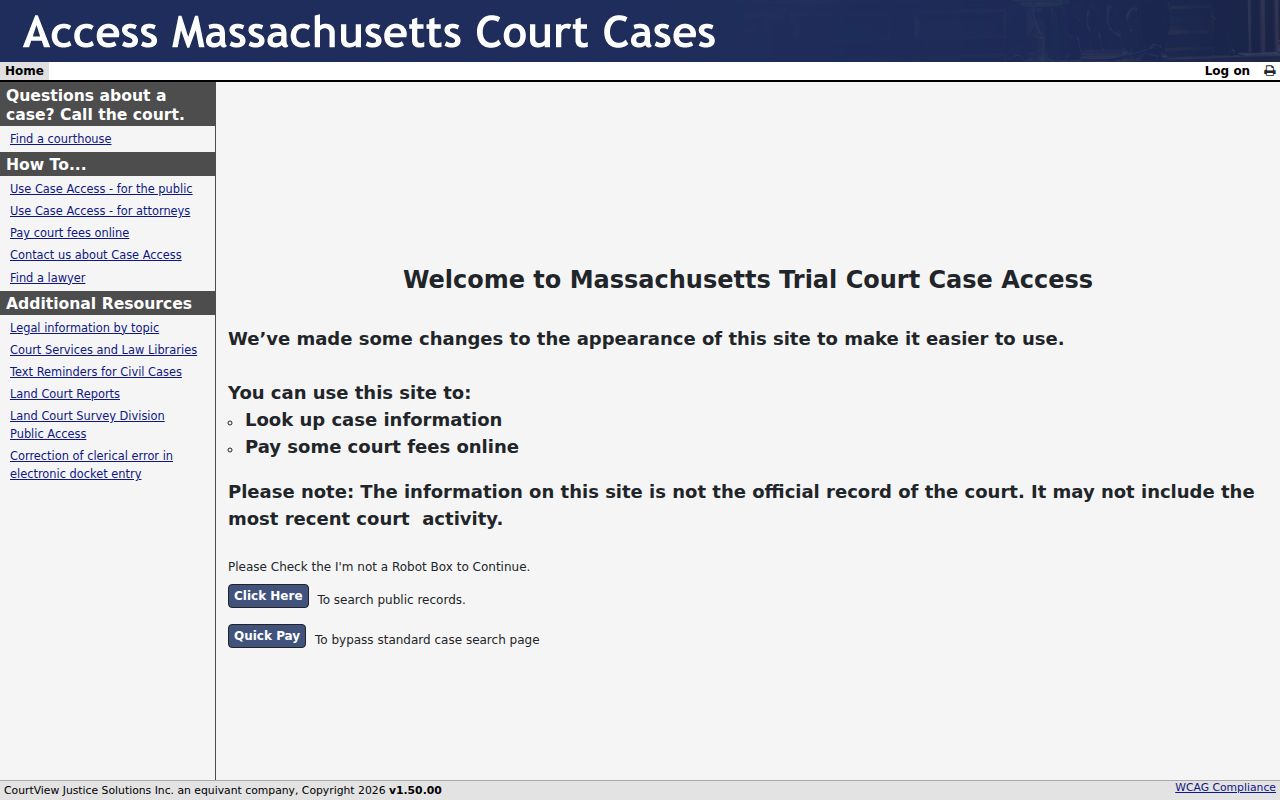
Remote case information can lag behind the docket. Document access varies by department and case type. Impounded, sealed, juvenile, adoption, and similar restricted matters stay out of public view, so treat any court result in a Springfield resident lookup as a dated clue rather than a current address claim.
Springfield Residents Directory Voter Limits
Massachusetts My Voter Registration Status exists for checking your own registration. It asks for first name, last name, date of birth, and the ZIP where the voter qualifies. Agreement to the form statement is also required. It is not a name-to-address directory. It cannot browse a street. A lawful local voter list may carry certain registration and address fields. But the statewide list is not public for unrestricted distribution.
Telephone, email, veteran status, permanent-absentee status, confidential-voter information, and minor or pre-registrant details are withheld. Springfield's annual street listing is a January 1 municipal record. It is not a freely searchable household database. That makes it a poor substitute for a residents directory. A request for a municipal voter file belongs with the Elections Office first. It should state the year, municipality, requested category, format, and scope.
Historical Springfield Residents Sources
Springfield City Library holds a near-complete local city-directory run covering 1866 through 1989. Selected volumes are digitized. Its local-history shelves add yearbooks, newspapers, obituary indexing, census access, and librarian appointments. The 1866-67 directory survives as a 240-image digitized volume listing households, businesses, and municipal officers. A directory year can pin a person or business to an address for that publication date. It proves nothing about present residence or ownership. For tracing past residents of Springfield, the Springfield Library Local History and Genealogy collection is the natural starting point. That is where the residents directory trail begins.
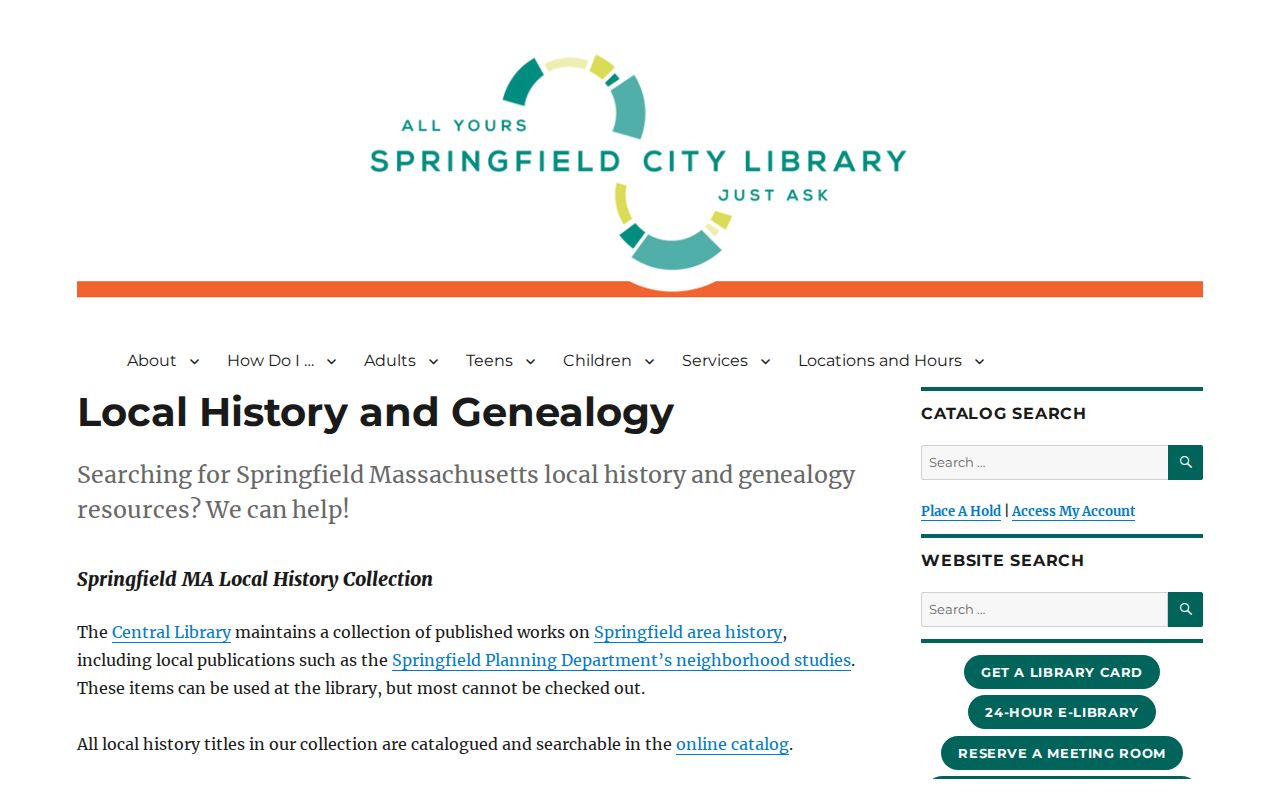
The Library's Republican Historical and Current archive reaches back to 1844. A 1946 press strike interrupted publication for months, a gap the Library itself notes. For working the directory volumes, the Springfield city directory page lays out the full historical workflow for past residents of Springfield.
Springfield Residents and Former Classmates
A former-classmate search is a historical trail, not a current-contact claim. Springfield Library holds selected college and public-high-school yearbooks. These span the early 1900s through the late 1980s, and many are digitized. One yearbook photo is thin evidence on its own. Pair the entry with a city directory, newspaper notice, obituary, or census snapshot. Name, year, school, street, and affiliation together beat a bare name every time.
The Springfield History Library & Archives deepens the shelf with French Canadian records, Ellis Island passenger indexes, the Loiselle Index, and microforms. It also keeps photographs, diaries, deeds, land records, and personal papers. Access varies item by item. Archive material can fix a past Springfield association while leaving today's whereabouts unknown.
Springfield Residents Directory Privacy Limits
Public access in Massachusetts has firm boundaries. The Address Confidentiality Program gives qualifying participants a substitute address and mail forwarding. Confidential voters stay out of ordinary state database exposure. G.L. c.66 §10B shields specified public-employee home addresses along with personal email and phone information. Motor-vehicle addresses offer no shortcut around those walls. Utility customer data, sealed or impounded court material, juvenile and adoption records, and restricted vital records offer none either.
Further privacy references include G.L. c.4 §7, c.66A, c.214 §1B, c.272 §99, and 201 CMR 17. A focused public-record request can pursue a non-exempt record. But no request overrides a confidentiality statute, court order, or protected-address program.
Lawful use. Use records for personal history, civic context, or careful reconnection. Never use a Springfield residents search to watch, contact, harass, or intimidate anyone; stop at protected information and rely on the custodian's lawful process.
Official Records and Commercial Listings
Commercial people-search products are compilations, not custodial records. They mash together public filings and historical addresses. Marketing data, self-reported material, licensed sources, and algorithmic matches get folded in too. An old address or a same-name match can be flat wrong. Treat any such listing as a prompt, not proof. Verify the specific fact with the recorder, assessor, or archive that created the underlying record. Do that before it enters your Springfield residents directory work.
| Question | Official Springfield or Massachusetts route | Commercial compilation category |
|---|---|---|
| Who holds a recorded property interest? | Assessor, tax record, and Hampden deed index with date and legal description | May merge property and old-address data without the controlling record |
| Can a voter field be checked? | Individual status form or lawful local-office request with protected fields withheld | Cannot override voter confidentiality rules |
| How is an error corrected? | Contact the assessor, Elections Office, court, Registry, or other custodian | Use the provider's own correction or opt-out process; source records remain separate |
Official results also need caution. A tax mailing line can differ from a parcel location. A court index can run incomplete, and any street directory is dated by nature. The offsetting advantage is clarity. The custodian, record type, and correction path are all identified.
Springfield Residents Records Requests
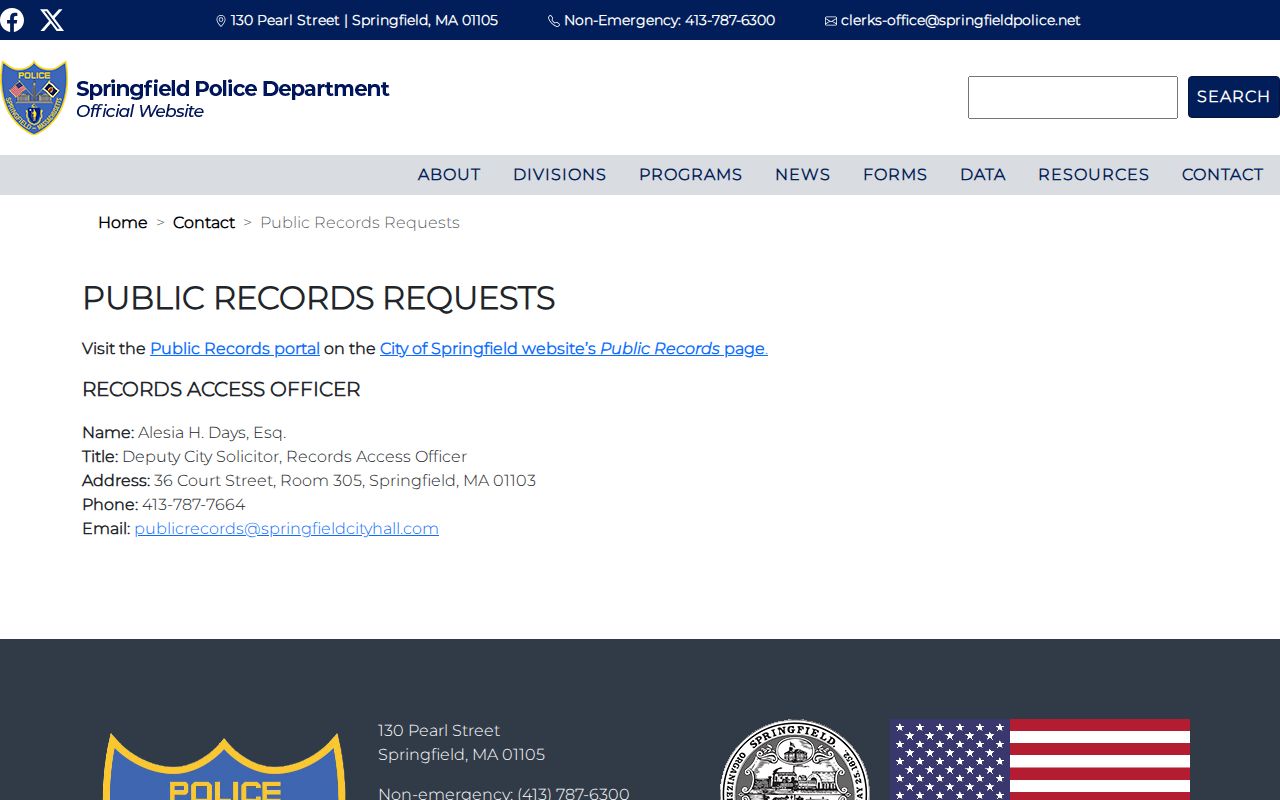
Springfield keeps most of its resident records behind counters, not portals. When a precise question has no online answer, the Massachusetts Public Records Law steps in. G.L. c.66 §10 lets anyone deliver a request by hand, by first-class mail, or by email. It all goes to the Records Access Officer. Describe the record reasonably. Name the address, year, record type, or office whenever you know it. Ask for electronic delivery where practical. The law calls for a response within ten business days. Any withholding, delay, or fee must come with a written explanation.
Some records have no live portal. For those, Springfield's public-records request contact gives the City a direct route.
Under 950 CMR 32.00, the first four hours of staff time are generally free. Hourly charges are capped at $25 without a special petition. Paper copies run about 5 cents per page. An agency should hand over an itemized good-faith estimate before any charge. Springfield requesters benefit from knowing these caps up front.
If a record is exempt, protected, or held by another custodian, adjust the request. Do not try to infer the missing information from a residents directory or street directory alone. Ask the Springfield records office that holds the record instead.