
Springfield Previous Residents by Era
Different records answer different parts of a house-history question. A recorded deed tracks a transfer of ownership, not every move. A directory can place a named person at an address in its publication year, while a census records a household on its enumeration date. Springfield records also have important format changes: the Registry’s convenient online searching differs before and after 1948, and the Library’s directory collection has its own date range. Use the closest source for the period first, then compare it with another record before treating a name as part of the address history.
| Record trail | Era available | Springfield access point | Address-history value |
|---|---|---|---|
| Hampden deed collection | 1636 to today | Hampden Registry online portal | Transfer parties, recording details, legal description, and deed references |
| Registered Land | 1899 to present | Hampden Registry Land Court route | Certificate, document, plan, and registered-title references |
| Springfield city directories | Near-complete local run, 1866 to 1989 | Springfield City Library | Published household, business, and address snapshots |
| State Library directories | 1846 and selected 1851 to 1968 holdings | State Library of Massachusetts | Earlier names and street entries when a local volume is absent |
| Federal census | 1790 to 1950 released | NARA and library databases | Household details at the enumeration date |
| Newspapers and microfilm | 1844 to present archive; listed film from 1900 | City Library and History Library | Notices, obituaries, legal events, moves, and deaths |
| Sanborn maps | Digital product, 1867 to 1970 | City Library and ProQuest | Building footprint, materials, use, and lot context, not occupants |
| Tax and permit records | Tax history back to 2004; permit start not verified | City portals and Code Enforcement | Tax, construction, alteration, inspection, or demolition timing clues |
For a recent transfer, start with the parcel and deed route. For an older household question, compare adjacent directory years, then add the census closest in time. Maps, tax history, and a permit file are supporting evidence. They can show a building change or a tax trail, but do not independently identify everyone who lived at the address.
Note: A result’s date matters more than its order in a search screen, especially after an address or ownership record changes.
Springfield Previous Resident Snapshot
Save today’s parcel information before moving backward. The Springfield assessor search accepts a parcel number or street address, and a street-only search can browse addresses on that street. Choose the correct autocomplete result. The assessor describes FY2026 property descriptions as of June 30, 2025, with values as of January 1, 2025. Those dates make the card a dated assessment record, not a live list of people at the property.
Then open the City Web GIS record for the same parcel. Its detail view can show the street address, owner, PID, land area, and assessed-value concepts, plus links to the Property Card and map views. Preserve the PID, parcel outline, lot number, building outline, street name, neighborhood, ZIP, and any historic or zoning context. City GIS carries many layers, including parcel, neighborhood, historic-district, ZIP, election, zoning, wetlands, and aerial layers. Those maps share an address but not a single boundary system, so label the layer and map date in your notes.
| Springfield assessor control | Input type | Use for the address trail |
|---|---|---|
| Parcel # | Optional text | Enter the parcel number, then choose the correct returned item. |
| Street | Optional text with autocomplete | Enter a full address or a street name alone to browse that Springfield street. |
| Popup selection | Autocomplete list | Select the matching parcel after typing; this is practically required for a reliable result. |
| Search | Button | Runs the parcel or address search. |
| Sort | Optional result control | Orders Springfield results by street number or owner name. |
Keep four values separate: the situs address, the owner name, the tax-bill mailing address, and the deed’s legal description. An owner may be an estate, trust, company, lender, or person living elsewhere. That distinction prevents a property record from being mistaken for a roster of previous residents.
Springfield Previous Residents Deed Chain
A deed chain follows ownership, which is often the best durable path behind an old street number. Open the current owner’s purchase instrument in the Hampden Registry of Deeds, then use the seller’s earlier purchase to move back another link. Record the document facts as you go. A name alone is not enough because trusts, entities, married names, initials, spelling variants, and former numbers can change the index path. The Registry’s Springfield municipality code is SPD where a municipality code is needed.
The Hampden Registry’s online deed-index search is the starting screen for the recorded-land portion of that chain.
Use the result to open the instrument and preserve its cited details. The index is a route to the deed image, while the image supplies the legal description and prior-reference details that help keep the chain tied to the right parcel.
| Hampden deed-result detail | Why it matters for a Springfield address |
|---|---|
| Party name | Identifies the indexed grantor or grantee, including a spelling or entity variant to test in the next link. |
| Municipality | Helps distinguish Springfield records when the result displays a municipality code or town context. |
| Book and page or document number | Retrieves the instrument image and preserves the citation for the chain. |
| Recording or entry date | Places the transfer in time and helps narrow the next earlier search. |
| Instrument and legal description | Shows the document category and the property wording that can survive a renumbered street. |
- Search the address in the assessor record. Save the PID, current owner, situs, snapshot date, property-card link, and any available legal-description detail.
- Check the same parcel in City GIS. Save the parcel shape and related map context, then use the Property Card link as a bridge back to the assessment record.
- In the Hampden Registry, search the current owner as the grantee in the post-1948 name or address index. Open the purchase deed rather than relying only on the result line.
- Capture the grantor, grantee, instrument type, recording date, book and page or document number, consideration if shown, legal description, and any prior-deed reference.
- Search that seller, now as grantee, to locate the seller’s purchase. Repeat this grantor-to-prior-grantee pattern one transfer at a time.
- When the trail predates the modern index, use the scanned Grantor or Grantee index, extract book and page, and retrieve the image through Book and Page. Switch to Registered Land when the records identify a certificate or registered title.
- Grantor and grantee
- The grantor transfers an interest in the property. The grantee receives it. Following each seller back to that seller’s earlier purchase is the basic backward-search method.
- Chain of title
- A dated sequence of recorded ownership instruments for the same property. It may include deeds, mortgages, releases, plans, and other documents, not a list of all occupants.
- Legal description
- The lot, plan, boundary, or certificate wording in a deed. It can remain useful when a street name or number changes.
- Criss-cross directory
- A directory arranged by street or address rather than just surname. Springfield’s exact reverse-directory years were not located, so confirm a volume with Central Library reference staff.
- Enumeration district
- The area a census taker was assigned to cover. It helps locate a household in a census image after the address and period are known.
Springfield Deed Index Divide
January 1, 1948 is the practical break in the Hampden online workflow. Documents after that date can be searched by name, address, book and page, year and instrument number, or entry date. For earlier records, the Registry directs researchers to select Grantor or Grantee, enter a surname with optional start and end years, open the scanned index book, and pull the book and page from the image. That reference is then used to reach the deed image.
The Registry’s Grantor and Grantee search instructions show the required earlier-record route.
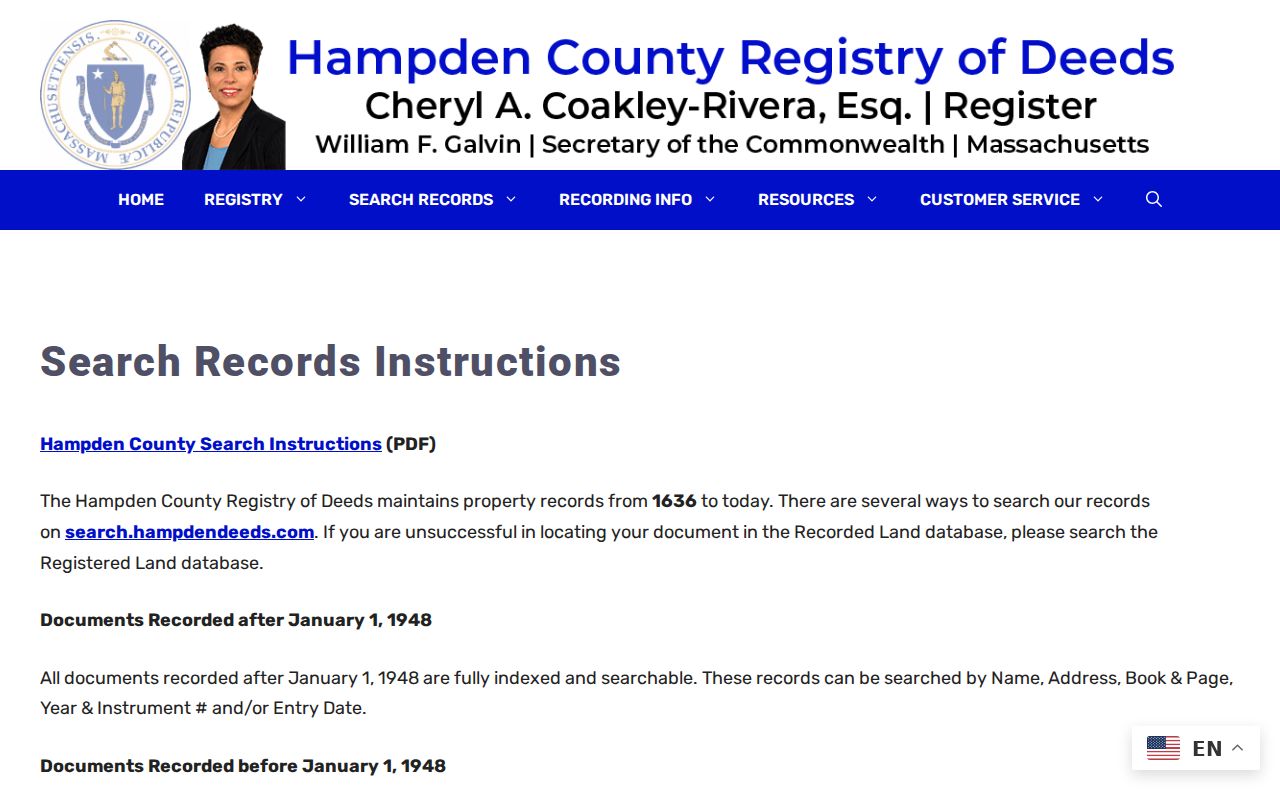
That instruction path is why an older deed search begins with a person or entity name instead of an address field. Once the book and page are taken from the scanned index, the document image can be retrieved and added to the same property timeline.
The deed collection reaches to 1636, but that does not mean every period has the same search screen. Search both sides of a name, including initials, spelling variants, married names, and entity names. A street-only search may fail where the deed relies on a legal description or an earlier address. Online deed copies are free according to the Registry; certified copies in person or by mail cost $1 per page. The Registry also warns about commercial mailers offering a certified deed copy for $121, so confirm copy needs with the Registry before paying.
Note: A scanned index image is a research step, not the deed itself, so retain the extracted book and page with the final document citation.
Springfield Registered Land Trail
Recorded Land and Registered Land do not use the same keys. The Hampden Registry advises trying Recorded Land first and then Registered Land if the search does not return the property. Registered Land and Land Court documents, indices, images, certificates, and plans are available online from 1899 to the present. Their route uses a certificate of title and document number instead of assuming that every result has an ordinary deed book and page.
Copy the exact grantor spelling from the certificate, along with certificate, lot, and plan details when shown. Registry assistance may be needed for a certified copy or to clarify the reference. Treat the different indexing system as a branch in the property trail, not a missing period.
Springfield Previous Residents in Directories
Ownership is only one layer of a past-address search. Springfield City Library holds a near-complete local directory run from 1866 to 1989, and the State Library lists earlier selected holdings beginning in 1846. Start with the volume nearest the event or address year, record the exact spelling, occupation or affiliation, residence notation, street number, and any business address. Compare the years just before and after it. A move can appear as a new address for the same name, while a new name at the same number may mark a different published household.
The digitized Springfield Directory for 1866–1867 provides a useful example of how an early address source is presented.

Its entries can separate a residence from a business address and use historical abbreviations such as h for house or home, bds for boarding or lodging, and cor for a corner. The publication is a dated snapshot, not proof of ownership or a complete list of people at an address. Past residents may appear in a directory without owning the Springfield property. For collection details and access options, use the Springfield city directory reference.
Springfield Residents Census Pairing
Pair a directory entry with the nearest released federal census to test a household trail. NARA census schedules from 1790 through 1950 are available under the 72-year release rule. A directory publication date and census enumeration date are different snapshots, so they can narrow a move period but do not establish an exact move day. The census can add age, relationship, occupation, and birthplace information to a household found through the address.
- Choose the directory year nearest the known address event and transcribe the name, number, residence notation, and any business line.
- Check the adjacent directory years for the same address and for the person under a new address, including a spelling or initial variation.
- Use the closest released census to locate the household. Note the enumeration date and district as part of the citation.
- Test a death, marriage, name change, or departure with a newspaper notice or obituary entry, then confirm a property transfer or estate filing where available.
The Library’s newspaper resources include NewsBank coverage from 1844 to the present and listed microfilm runs from 1900. Its documented 1946 newspaper press strike explains a real break in the Springfield newspaper trail. Do not turn a gap in one title into evidence that a family disappeared from Springfield.
Springfield House Maps and Permits
Building evidence can explain when an address changed form, but it cannot identify a past household by itself. Springfield Preservation’s building-history guide describes 1899 Richards atlas plates for all of Springfield, a 1910 Springfield and Longmeadow atlas, a 1912 Richards Standard Atlas of Hampden County with a Springfield street map, and a 1920 atlas with a rear street-by-street owner appendix. The maps can show street names and numbers, lot lines, building outlines, materials, and, in some sources, owner labels.
Digital Sanborn Maps covers 1867 to 1970 as a product, although the exact Springfield sheet-year list was not located. Use it for structure, use, and footprint context rather than occupant proof. City OpenGov permit and code files can add construction, alteration, conversion, demolition, or inspection timing. The public portal’s exact search fields and coverage start were not verified, so request a specific address, year, and file type if a historic permit record is needed.
Note: Atlas labels and permit names date a property event or building feature; they do not by themselves prove a person lived there.
Springfield Address Number Changes
Never assume an older street number is a fixed key. Springfield Museums documents that Johnson’s Bookstore at 391–395 Main became 1379 Main after a Main Street renumbering in the 1920s. The business had moved there in 1909. That local example calls for searching the old number, the current number, the business or person name, the atlas plate, and the deed legal description together.
City Chapter 143 assigns present numbering to the Director of Public Works, with numbers generally running continuously along a street and odd and even sides assigned as practicable. Renumbering requires action by the Mayor and City Council. That rule describes the current system; it does not convert every historical number into a modern parcel identity.
Lawful Springfield Previous Residents Research
Use address history for family research, a house history, heir research, or personal civic curiosity. Stop at the boundary of a protected record. Current non-owner occupants may not appear in property records, utility customer data is not public, and Massachusetts protections cover confidential voters, Address Confidentiality Program participants, certain public employees, sealed or impounded court files, juvenile records, adoption records, and restricted vital records.
Lawful personal use. Massachusetts law addresses stalking in M.G.L. c.265 §43 and criminal harassment in §43A. Public-record status is not permission to monitor, contact, threaten, or track a living person. Request only non-exempt records from the proper custodian and respect every confidentiality limit.
When an estate or death notice ends the chain, use it as a lead rather than a final answer. A notice may identify a surviving spouse, children, funeral home, or prior street; an estate docket may identify a personal representative, heirs, or a disposition. Confirm the relationship and property connection against a deed, certified record, or the responsible court’s file. For a question about who lived here before, the Springfield History Library & Archives can be the escalation point for diaries, deeds, land records, account books, and personal papers when the online trail stops.